
•Overview
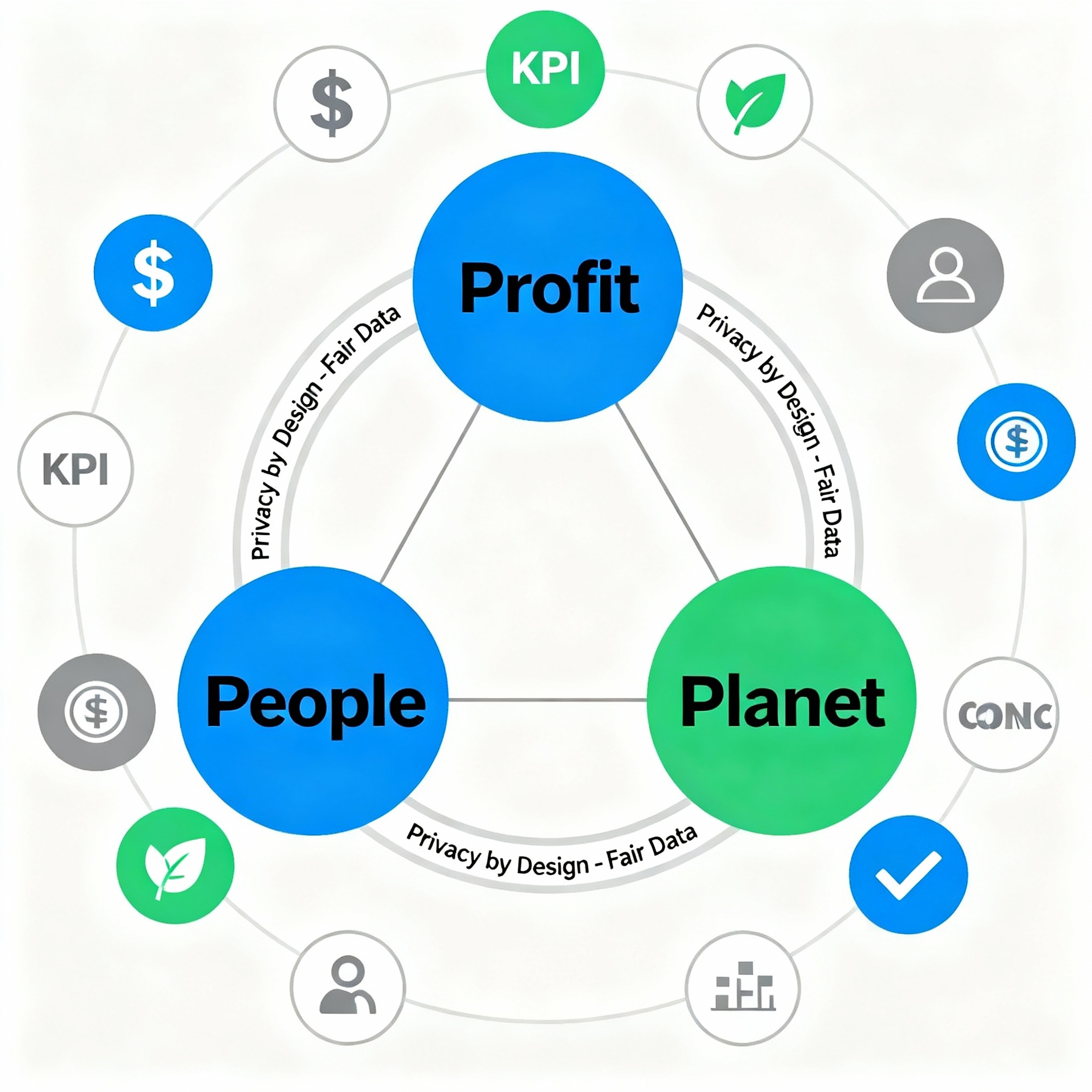
In today’s data‑driven markets, real prosperity means optimizing for financial performance and auditable impact at the same time, not one after the other.
Market trust depends on perceived fairness in how data is collected and used, making privacy and procedural justice central to engagement and loyalty.
•What the impact economy is
The impact economy integrates profit with social and environmental value by embedding shared development goals directly into strategy, governance, and measurement rather than treating them as externalities.
Governments and companies share responsibility for sustainable development and can reinforce one another when incentives and standards are aligned for joint financial‑and‑impact performance.
•Why it matters now
Economies are healthier when growth reduces systemic risks—like climate stress and inequality—while broadening welfare beyond narrow indicators such as quarterly EPS or GDP alone.
Integrating impact into core decisions lowers externalized costs and better aligns capital with long‑term value creation across the economic, social, and environmental pillars.
•Trust through fair data
Consumer privacy concerns are fundamentally about perceived justice in information practices, so fairness in data collection, use, and explanation directly shapes adoption and retention.
Clear notices, specific consent, minimal collection, and transparent explanations of outcomes increase willingness to share data and remain engaged.
•Three pillars of balance
- Align profit and impact: treat impact targets as constraints in product, pricing, and capital allocation—not as a separate CSR track.
- Expand responsibility: coordinate public benchmarks with corporate incentives so verified outcomes are rewarded over intentions or narratives.
- Make fairness core: bake privacy and procedural justice into every customer interaction to support durable market participation.
•A practical playbook
- Strategy: choose a small set of material impact objectives and translate them into roadmap, procurement, and go‑to‑market requirements.
- Incentives: tie executive compensation and approvals to both P&L and auditable impact KPIs so trade‑offs are explicit and time‑boxed.
- Trust by design: map data flows, minimize collection, explain uses plainly, and provide real choices aligned with justice expectations.
•Metrics that matter
Use an integrated KPI stack so financial and impact metrics move together in decisions, preventing last‑minute trade‑downs at quarter‑end.
Pair revenue, margin, and cash flow with auditable outcome indicators for people and planet to enable joint optimization and accountability.
•Start‑up KPI list
- Carbon and resource intensity per unit revenue to anchor genuine efficiency gains rather than offset‑heavy accounting.
- Living‑wage coverage and safe‑hours compliance across operations and tier‑1 suppliers to quantify fair work.
- Customer justice score from privacy UX research to capture perceived fairness and guide consent and control design.
•Risks to avoid
- Impact‑washing via vague claims or vanity metrics that are not verifiable or comparable across time and peers.
- Siloed compliance that treats privacy and sustainability as paperwork instead of performance outcomes tied to incentives.
- Misaligned rewards that favor short‑term gains while shifting costs to communities or the environment.
•A 30‑60‑90 launch plan
- First 30 days:
Select two material impact goals tied to enterprise value, define no more than five auditable KPIs, and baseline them. - Next 60 days:
Hard‑wire these KPIs into product gates, pricing reviews, and capital approvals, and pilot integrated reporting beside financials. - Next 90 days:
Align rewards, implement privacy‑by‑design across key journeys, and establish a recurring internal review cadence.
•Governing that keeps you honest
Seat a cross‑functional impact committee with finance and strategy so trade‑offs are documented, time‑boxed, and transparent to stakeholders.
Invite periodic external reviews to stress‑test metrics and narratives for decision‑usefulness, comparability, and credibility over time.
•FAQs
- What is the impact economy?
It is a model where firms and policymakers jointly manage for profit and measurable impact with shared goals embedded into core decisions and metrics. - How is this different from CSR?
CSR often sits adjacent to strategy, while the impact economy integrates outcomes into product, pricing, and capital allocation with auditable KPIs. - Why focus on data fairness?
Perceived justice in information practices drives trust, consent, and engagement, which shape growth and customer lifetime value.
•References
- The Impact Economy: Balancing Profit and Impact, Bruegel Working Paper 2020/04, by D. Schoenmaker.
- Culnan, M. J., and Bies, R. J., “Consumer Privacy: Balancing Economic and Justice Considerations,” Journal of Social Issues, 59(2), 323–342.

0 Comments